
Home / About / Retreats / Blog / Writers of Colour Bursaries / Anthology / Links / Success Stories / Recent Milfords / Recent Retreats / Past Milfords / Contact
All about the Milford SF Writers' Conference - and how to book.
Booking open now
Milford Saturday 12th - Saturday 19th September 2026 will cost £1056 for the week.
A non-refundable deposit £250.
Balance of £806 payable 12 weeks before the event.
BOOKING FORM for Milford 2026 HERE
Questions? Email the secretary jacey@jaceybedford.co.uk
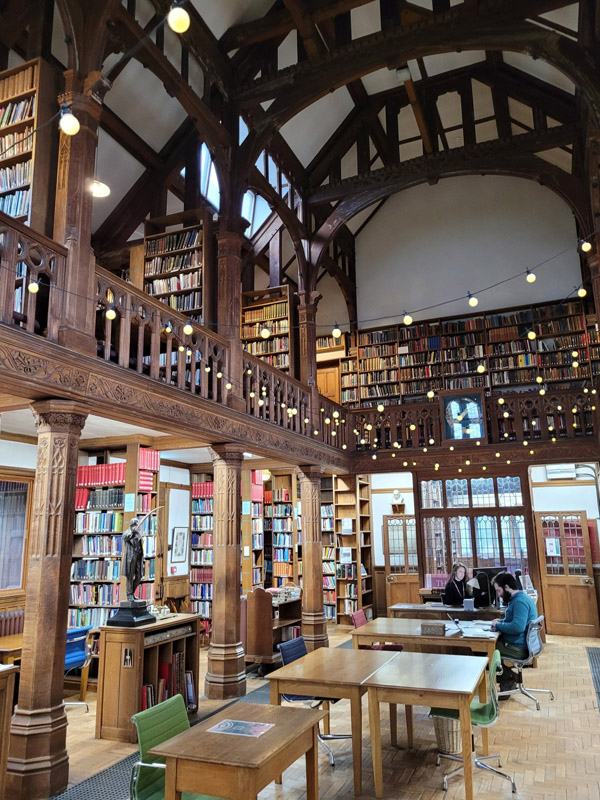 VENUE: Gladstones Library, Church Lane, Hawarden, Flintshire, North Wales, CH5 3DF. (Close to Chester)
Note: Hawarden is pronounced Ha'rden
The conference is the longest-running SF writers' event in the UK. It has been a regular (and almost) annual occurrence since 1972, drawing members from the UK, Europe, America, Asia, Africa and Australia. It has settled into a comfortable, workable format: demanding and exhausting, but also convivial. In short, it's a social as well as a literary event--a chance to connect with other writers.
Many famous names have passed through Milford in its (more than) five decades in the UK. : Anne McCaffrey, Brian Aldiss, Bruce Sterling, Charles Stross, Chris Priest, Diana Wynne Jones, George R.R. Martin, Alastair Reynolds, Jaine Fenn, Karen Traviss, Kari Sperring and Liz Williams. Some attendees are novel-writers, others specialise in short stories.
A few places will be ring-fenced for Milford first-timers until the Easter weekend immediately before the event. (Though it can book up earlier than this.) Once that deadline has passed any unsold places are open to everyone on a first come, first served basis.Anyone on the waiting list will be at the front of the queue if/when places open up.
Minimum qualification for attending Milford
-
Minimum qualification for attending Milford is one fiction sale to any recognised market.
What Happens
-
Writers give and receive critique of ongoing work, discuss ideas, and socialise.
-
At least 2 weeks before the event, each participant submits up to 10,000 words in one or two pieces (short stories or novel excepts) for critting. Any story-so-far, notes, synopses or specific queries should be in the manuscript document and should be included in the word count.
-
The pieces are timetabled for critique using the Milford Method throughout the week.We encourage constructive rather than destructive critique. It's the work being critiqued, not the individual authors.
Milford Method
-
Milford rules allow even the shyest member's voice to be heard.
-
Each participant, in rotation, spends up to three minutes (timed) giving their critique of the work at hand. Once the three minute timer goes off, you may complete your sentence to wind up.
-
No interruption, whether by the author or anyone else, is allowed during this stage of the proceedings.
-
After everyone has spoken the author gets an uninterrupted right of reply.
-
This is followed by a more general discussion.
Outline of the Week
- Beforehand — Participants must distribute their manuscripts by email at least 2 weeks before the workshop begins, and preferably 4 weeks. This gives people the chance to read MS in advance, reducing the workload during the week itself. You will already have had the week's timetable, setting out when each MS will be discussed.
- Saturday — Arrive any time. You can get into your room from 4 p.m. onwards, but if you arrive early you can use the library or the common room, or visit the cafe. There's no programme on the first day, just dinner at Gladstone's, and getting to know each other afterwards in the comfy common room.
- Daily Timetable — Breakfast from 8.00 to 9.30. Lunch (optional) is 12.30 . Dinner at 6.30 p.m. (You make your choice from the dinner menu at breakfast.)
- Sunday to Thursday — These are the main working days. Mornings are free. Critique sessions are in the afternoons, from 2.00 p.m. until 5.00 p.m.-ish) in a private room (boardroom table and chairs). As a resident you can work in the library any time between 9.00 a.m. and 10.00 p.m.
- Wednesday — Milford is legally constituted so that the current 'members' (i.e. this year's attendees) are obliged to hold an AGM and elect officers for the coming year, thus each Milford provides for the next. It takes about half an hour after dinner.
- Thursday — The evening generally includes a markets session, discussing where the week's pieces could usefully be submitted on completion.
- Friday — Usually this is a free day, in which we can visit nearby places of interest, but it's always a fall-back day in case the workload is too heavy and additional critting time has to be scheduled. You can, of course, always decide to stay and work in the library.
- Saturday — Depart after breakfast. Or you can stick around to write for a few hours as long as you vacate your room by 10 a.m.
- Afterwards — Attendees go on the Milford mail list. Groups often keep in touch. If your story is published please let us know for our Success Stories page.
Preparation
- Our one truly inflexible requirement is that you must send, in advance, one or two pieces of unpublished work for critique. Aim for below 10,000 words in total. Complete stories or novel excerpts are acceptable. Leading and/or trailing synopses must be in your document and included in your word count.
- Works may be any kind of speculative fiction: science fiction, fantasy, horror, or ambiguous genres such as slipstream, alt. history etc. (for adults or children).
- Correct manuscript format isn't necessarily required as long as it's clear and readable. Word doc or .docx is the norm, but you can also submit in RTF.
-
What to bring. Just yourself and your work. If you haven't been to North Wales in September before, please be aware that the weather can be changeable. Dress is whatever you feel comfortable in. We're not very formal. There are walks around Hawarden village and through the castle grounds (though the castle itself is privately owned).
- There's an honesty bar in the common room. Write what you've had in the book and pay at the end of the week. Pay at the end of the week for any lunches you've had.
Venue
-
Gladstone's Library is the only residential Library in the UK. Yes, it was built by THAT William Gladstone, Queen Victoria's prime minister, and is now a registered charity.
-
It is 8 miles from Chester, accessible by taxi or bus from Chester where there is a mainline railway station. It's easily accessible by road via the motorway network and there is a small car park. Please note if you are driving that a lot of Welsh speed linits are reduced to 20 miles per house in built up areas. Please don't get a ticket on your way in or out.
-
As a resident you have full use of the pin-drop-silent library itself from 9.00 a.m. to 10.00 p.m.
-
Gladstones is a Victorian Gothic building with the library, restaurant, comfy common room and well-appointed ensuite bedrooms, each complete with a writing desk and radio. There are two accessible ground floor rooms as well as bedrooms on the first and second floors..There is no lift.
-
There is a dedicated conference room on the ground floor.
-
Accommodation is bed, breakfast and evening meal. The menu choice includes vegan, vegetarian and meat or fish meals. There are tea/coffee making facilities in your room or the cafe serves all day. You can buy lunch in the cafe or there are pubs, a couple of small cafes, and a small post office and general store in the village (it has a small selection of sandwiches and snacks). There's also a pharmacy (closed on Saturdays). Everything is within very easy walking distance. There is a large supermarket a short drive away.
What it Costs
- The total cost of the Milford week in 2026 is £1056 for accommodation in a single ensuite room. There's a non-refundable deposit of £250 payable on booking, and the balance of £806 payable 12 weeks in advance.
- Once the event fills up, there is a waiting list which you can join by filling in the application form and paying the deposit. We will hold this until the booking is either confirmed or cancelled. If no one drops out and you don't get a place you will get a full refund or you can take a place on the next available Milford and carry your deposit over.
- There is a ceiling of 15 members for the workshop, though it might also be possible to have some people doing a retreat alongside the critiquers, depending on room availability. Talk to us if that's what you want to do.
Cancellation - The Small Print Writ Large
- We regret that we can't refund deposits, once paid, as we pay it forward to the venue.
- We advise Milford attendees to take out cancellation insurance to protect themselves from loss in the case of lost deposits or full fees. PLEASE NOTE IN THE EVENT OF A NATIONAL COVID/PANDEMIC CANCELLATION, DEPOSITS CAN BE ROLLED ON TO A FUTURE MILFORD.
- Once the balance of payment has been made there is no refund if you don't attend, as once we have booked and paid for your place.
- Non-payment of the balance owed 12 weeks before the event might mean you lose your place. Talk to us if you have a problem.
Inclusion, Access, and Equal Opportunities - (From our constitution)
-
STATEMENT OF INCLUSION. Milford's critique week is open to all professionally published writers of SF/F, over the age of eighteen and writing in English.
-
EQUAL OPPORTUNITIES POLICY. All published writers of SF/F are welcome, regardless of gender, marital status, race, ethnic origin, colour, nationality, national origin, disability, sexual orientation, religion, age, or planet of origin.
-
ACCESS. Milford will always do its very best to ensure access for writers with mobility problems and to comply with all the laws of the land regarding physical access. Please note that Gladstone's Library is a listed building and has no lifts. The library, common room and meeting room are all on the ground floor with level access. There are only two ground floor bedrooms which will be allocated on the grounds of greatest need. These are classed as 'access' rooms, but not really suitable for all disabilities. Please talk to us if you foresee a problem.